
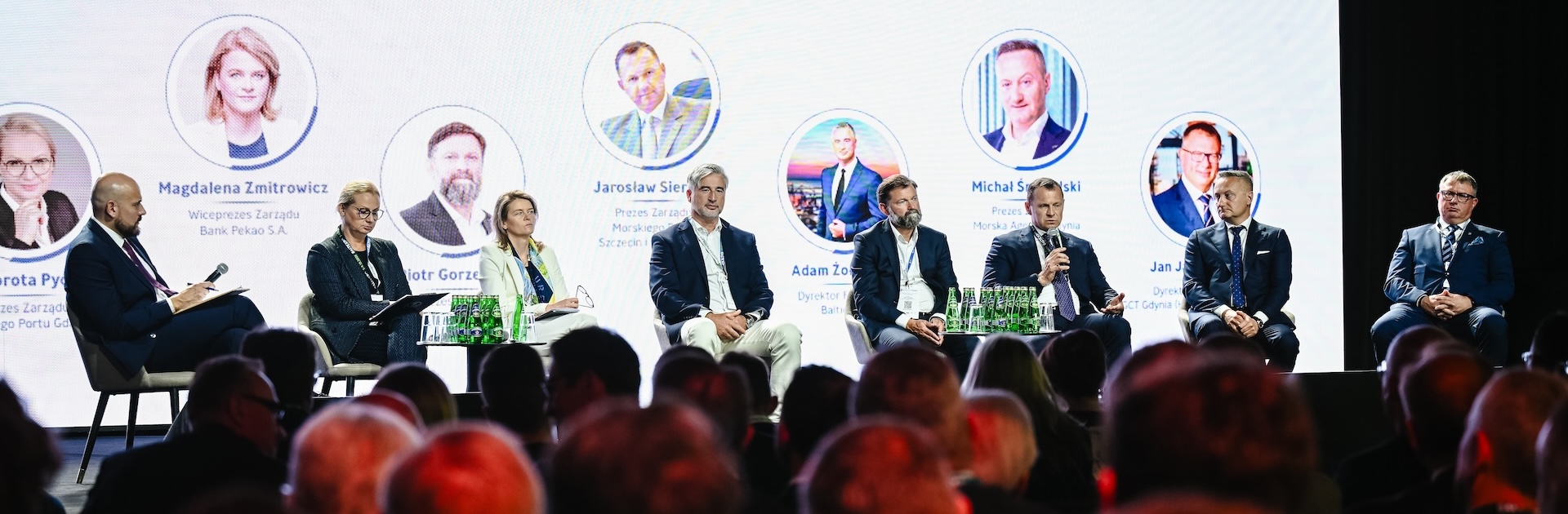
On 23–24 June 2026, the Radisson Blu hotel in Sopot will host the fourth edition of the nationwide conference fully dedicated to the maritime port sector – the Ports of Poland 2030 Congress. The previous edition of the Congress was a great success and one of the largest economic events in the region. It brought together over 900 participants and more than 90 speakers. This year we are expecting an even higher turnout. Let us meet and discuss the future and development directions of Polish ports. The programme includes 10 thematic panels, presentations, lectures, and the presence of representatives of the most important companies and institutions.
The conference is held under the honorary patronage of the Ministry of Infrastructure, with the main media patronage of the Polish Press Agency. Partners of the conference include the Port of Gdańsk Authority, Port of Gdynia Authority, Maritime Agency Gdynia, Baltic Hub, Szczecin and Świnoujście Seaports Authority, HES, Naftoport, ERBUD, Bulk Cargo - Port Szczecin, BLG Logistics, Solid Port, BCT Gdynia, and many others. The congress is organised by the publisher of GospodarkaMorska.pl.
Over the past years, seaports have been one of the fastest-growing sectors of the Polish economy. The scale of this growth is best illustrated by the numbers. In 2012, Polish ports handled a total of 63.974 million tonnes, while in 2023 this figure had already reached 146.4 million tonnes. The results of individual ports are equally impressive. In 2012, the Port of Gdańsk handled 26.9 million tonnes, while in 2023 it reached as much as 81 million tonnes. Cargo handling in the Port of Gdynia increased from 15.8 million tonnes in 2012 to 28.2 million tonnes in 2022. The port complex of Szczecin and Świnoujście handled 21.3 million tonnes in 2012, and 36.8 million tonnes ten years later.
At the same time, within just over a decade, Poland has become a leader in container handling on the Baltic Sea, and the Port of Gdańsk has become a regional hub with key intercontinental connections. This dynamic growth has driven the expansion of the Baltic Hub terminal in Gdańsk. The Baltic Hub terminal has been expanded with a new T3 quay, which has increased its handling capacity to 4.5 million TEU annually. The BCT and GCT container terminals in Gdynia have also significantly expanded their capacity and throughput in recent years. Moreover, a deep-water container terminal in Świnoujście has been announced, which has the potential to become the second strongest container hub on the Polish coast after Gdańsk. The investment is expected to cost over 10 billion PLN and will include a range of components – apart from the container terminal itself with a capacity of 2 million TEU per year, also an approach channel and a breakwater.
The growing importance and role of Polish ports is not defined solely by numbers. Ten years ago, the dependence of Poland’s energy system on ports was marginal. Today, the majority of raw energy materials are delivered to Poland by sea. This is evidenced by record cargo volumes at Gdańsk’s Naftoport or the fuel terminal in the Port of Gdynia, investments in PERN’s fuel base in the Northern Port of Gdańsk and in Gdynia Dębogórze, the success and further expansion of the LNG terminal in Świnoujście, the construction of the Baltic Pipe pipeline, the FSRU terminal in the Bay of Gdańsk, a small-scale LNG transshipment terminal in the vicinity of the Gdańsk Refinery, and finally the decision to build an offshore wind installation terminal in Świnoujście.
Few anticipated such a scale of investment and such dynamic development directed towards seaports. In the reality of the war in Ukraine and Poland’s cut-off from Russian energy supplies, some port terminals had to adapt quickly to new needs, primarily increased coal imports. Moreover, such cargoes occasionally appeared even in smaller ports previously focused on fishing and tourism. Investments of recent years have become a safeguard against a deep crisis.
The development of ports would not have been possible without a series of key infrastructure investments carried out in recent years by Maritime Offices, Port Authorities, and rail and road companies. Multi-billion zloty projects have ensured Poland’s supply security in critical moments. Port infrastructure and superstructure in Polish ports have developed significantly. Port basins and waterways are systematically deepened to allow larger vessels to enter. New quays and terminals have been built, while existing ones are being modernised to handle increasingly large ships. Modern cargo-handling equipment operates on the quays themselves.
The port surroundings are also developing. Warehouses, handling and logistics yards, parking areas, and logistics valleys are expanding. However, port development alone is not enough. It must be accompanied by the expansion and improvement of the transport of goods to and from the quays and further inland. Major railway infrastructure investments in port hinterlands have been carried out by PKP Polish Railway Lines. Thanks to them, more goods can already be transported to and from ships by rail. Important road investments have also begun, which may completely change the functioning of port cities. Above all, design work has started on the so-called Red Road in Gdynia, which is intended to serve as the main truck route to the port. In Gdańsk, Szczecin, and Świnoujście, local authorities and the state are also implementing further plans to enable ports to handle as many trucked goods as possible without unnecessary urban congestion.
But port investments are not limited to Gdańsk, Gdynia, Szczecin, and Świnoujście. Smaller ports on the Polish coast are also developing, with offshore wind expected to play an important role. It has already been announced that service bases for Polish wind farms will be located in Łeba and Ustka. Other ports also hope that vessels involved in the construction and operation of Baltic wind farms will become frequent visitors.
One of the most high-profile maritime investments in recent years has been the Vistula Spit canal along with the construction of a navigation channel from the Gulf of Gdańsk to the Vistula Lagoon and further, via the Elbląg River, to the Port of Elbląg. This port is in turn being positioned as one that may benefit the most from these changes and develop strongly in the coming years.
All these threads – energy security, supply chains, the push for green solutions in ports and shipping, and many others – come together in the concept of the smart port, which port and terminal operators are increasingly considering. Digitalisation of maritime transport is no longer science fiction but reality. It already brings tangible benefits, improving the safety, quality, and speed of vessel and cargo handling. However, it also brings new challenges, such as the need to protect against increasingly frequent cyberattacks.
Inland shipping in the Netherlands in 2022 amounted to 370 million tonnes of cargo transported by nearly 5,000 vessels, with a 6% increase. In Poland, the same year saw just 3.6 million tonnes and a decline of over 13%. At the same time, almost all vessels are over 45 years old.
Thus, inland waterways transport in Poland, neglected for years, finds itself at a crossroads between plans and ambitions on one side and environmental regulations and constraints on the other. However, economic calculations and the experience of other European countries, as well as our own, show that this transport sector can be both efficient, profitable, and environmentally friendly. It does, however, require rebuilding almost from scratch. Polish rivers must be made navigable again and the necessary infrastructure developed, ideally capable of handling modern, eco-friendly vessels powered by clean, zero-emission fuels.
Access to new technologies in construction, ever larger ships and cargo volumes, and the dynamic growth of cities mean that the largest ports must move further into the sea. This can be seen in the development directions of ports such as Rotterdam, which is building its Maasvlakte, or Antwerp. Ambition and long-term vision have always increased port potential.
Over 100 years ago, Eugeniusz Kwiatkowski and Tadeusz Wenda understood this, ensuring decades of growth for Gdynia. The next major port project, the Gdańsk Northern Port, had to wait until the 1970s and remains the largest bulk hub on the Polish coast to this day. Once again, Australians reminded us of port potential by building a container terminal on the beach in Stogi over a decade ago. Many were sceptical and doubtful. Today, Baltic Hub is the largest container terminal and transport hub in the Baltic Sea region.
A few years ago, the LNG terminal in Świnoujście was commissioned. There was also no shortage of opponents. Today, deliveries of gas, oil, coal, and other raw materials through Polish ports are protecting us from a deep energy crisis.
The time has come once again to look far into the future and far out to sea. The economic climate and geopolitical situation leave no doubt. It is time to implement the next major projects. The T3 and T5 terminals at Baltic Hub, the FSRU terminal in Gdańsk, the offshore wind installation terminal in Świnoujście, and the container terminal in Świnoujście – these are the investments we are already waiting for.
What about the Central Port in Gdańsk and the Outer Port in Gdynia? Each of these projects has great potential and its own conditions, and they will also be discussed during the upcoming Congress.
By 2030, Polish ports will look completely different. Along with the rest of the world, we have entered a path of ecology and digitalisation, based not only on legal regulations but above all on sustainable development. Polish ports – both those of strategic importance to the national economy and smaller ones managed by local authorities – face a major opportunity.
There are truly many possibilities. How can they be best used? Which are the most promising and offer the best prospects? How should we prepare not only for the coming years but for decades ahead? All of this will be discussed by experts and practitioners during the third edition of the Polish Ports 2030 Congress.